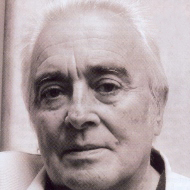
The composer Jiri Kalach was brought up in a musical family. His father (Josef) was a composer, violist and a founder member of the Symphony Orchestra of the Barrandov Film Studios. After finishing grammar school he entered the Prague Conservatory, where his teachers were Frantisek Picha, Frantisek Broz and Emil Hlobil. In 1957 Jiri Kalach graduated with a violin concerto and went on to the Academy of Music and Performing Arts. He graduated in 1961 (his degree composition was the Concerto for Flute and Orchestra) and afterwards worked as a free lance composer. Since 1990 he has been working as a repertory manager at the Symphony orchestra of Czechoslovak (from 1993 Czech) Radio.
Looking at the list of his works we can see mainly instrumental compositions including five symphonies, his chamber compositions include six string quartets, three violin sonatas and many other works.The following four compositions, written between 1984 and 1990, represent the high point, both artistic and philosophical, of Jiri Kalach\'s work. Above all it\'s worth mentioning that his Rhapsody for violin, mixed chorus, harp and percussion Lukumo (1984) was inspired by Mika Valtari\'s novel Mysterious Etruscan. His further major symphonic work Erasmus (1988) is a meditation for violn and orchestra celebrating Erasmus of Rotterdam. In the third composition Hommage a Albert Schweitzer (1989) for mixed choir, organ and orchestra, the composer depicts Albert Schweitzer as a humanist, scientist and musician. The text of this work is based on the Latin version of the Hippocratic oath. Jiri Kalach considers Albert Schweitzer to be a person who fully adhered to this oath. Czech Rhapsody (1990) is an orchestral composition concluded by the old Czech Lord\' s Prayer.
Composing music to the film Mourning Ceremony, directed by Zdenek Sirovy (1969), was an interesting deviation from his strictly and purposefully planned orchestral compositions. Unfortunately, during \"normalization\" the official communist authorities banned the screening of the film. It was premiered only after twenty years and in 1990 awarded by the Grand Prix of Montreal.
In his earlier compositions, Jiri Kalach followed the established modern music styles. The break point was writing his Fourth String Quartet in the early 1970s, where he first used the dodecaphonic technique. He used this technique as a basis for creating his own method of musical expression but not in a conventional way. His compositions are rationally constructed, but they have emotional stress, strong dramatic elements and they pulsate with rich rhythm and contrasts of expression.